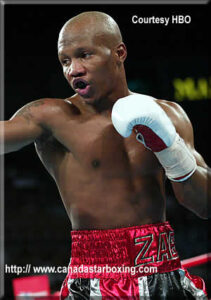
SHANE MOSLEY
PROFILE AND BIO
Shane Mosley scaled every mountain there was to climb in boxing. He's fought his way to world championships at lightweight, welterweight, and junior middleweight, became known as the best pound-for-pound fighter in boxing and has become a household name to boxing enthusiasts.
Mosley has consistently overcome the odds since turning pro. Mosley came up the hard way, fought the best competition, won his fights, and eventually won three world titles, earning the 1998 Fighter of the Year award along the way.
Mosley showed brilliance in his professional debut, a five round blowout of former California State champion Greg Puente on February 11, 1993, and his future looked bright. Unfortunately, promotional difficulties plagued his early career, and the boxing world would not take notice of Mosley until he brought a 23-0 record (22 knockouts) into the ring against IBF lightweight champion Phillip Holiday. Displaying speed, power, and ring savvy, Mosley thrashed Holiday over 12 rounds and walked away with a world title. He followed up this win with an 11th round knockout of tough Manuel Gomez.
Mosley’s subsequent title defenses caught an unsuspecting boxing public by surprise. Knockout after knockout piled up, as did the accolades from the media. HBO commentator and world champion Roy Jones Jr. proclaimed, after Mosley knocked out John John Molina, “He’s the best lightweight in history, maybe after Roberto Duran.”
In 1998, Mosley defended his title five times, winning all by knockout. This amazing twelve months led the Boxing Writers Association of America to name “Sugar” Shane “Fighter of the Year”. As BWAA president Chris Thorne said, “Sugar brought a lot of class to boxing in 1998. He deserves all accolades he’s receiving.”
Mosley continued his reign of terror in 1999, defending his title two more times by knockout before difficulties making the 135 pound limit proved tougher than any opponent. While it would have been simpler for Shane to move up five pounds to junior welterweight, “Sugar” wanted to go to where the toughest opponents were: welterweight.
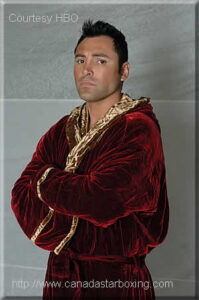
It was at welterweight that the most notable win of the first half of Shane's career occurred, when in June 2000, he clearly outboxed cross-town rival Oscar De La Hoya and won the WBC Welterweight Title.
It was only the third fight at 147 pounds for Mosley, a move many critics questioned, and those critics weren't silenced even after resounding wins over Wilfredo Rivera and Willy Wise at welterweight. De La Hoya, though, found out what power boxing is all about that night.
Power boxing is the concept that Shane and his father Jack developed, taking advantage of Shane's superb conditioning and extraordinarily high punch output.
The fight with De La Hoya was close at the midway point, but Shane picked up the pace considerably in the second half of the fight. Many experts believe Shane swept rounds 7 through 12, but there was no doubt when the bout was over that Shane was the new King of the Welterweights.
De La Hoya declined an immediate rematch, so Mosley sought the best competition he could find. Antonio Diaz was one of the toughest men in the division, but Shane was better in every area and stopped him in the sixth round in November 2000. "Shane is good, real good," Diaz said. "He's the best I've ever seen."
The following March, Shane dismantled Australian Shannan Taylor, who had been highly regarded by the media. Many felt he would provide Shane a stiff test, but that was not to be. Taylor wasn't nearly as fast or as strong as Mosley, who stopped him in the sixth round in March 2001..
He then cut down former junior middleweight Adrian Stone in July needing only three rounds to stop the bigger man.
By then, he was universally regarded as one of the top three pound-for-pound fighters in boxing and was considered the best by a large number of experts.
Shane, who turned 30 in September 2001, called out Vernon Forrest, who was the best available 147-pounder. Shane's power boxing allowed him to dominate the first round, but things turned in the second. An accidental head butt in the second round turned the fight around and Forrest went on to score a decision. Later in the year, Mosley was again unable to solve Forrest, in what will go down as one the best fight series of the year.
Mosley put his frustrating 2002 behind him and after a no contest with former world champion Raul Marquez in February 2003, Sugar Shane returned to the win column in a big way in September 2003, when he scored a hard fought unanimous decision over De La Hoya in their long anticipated rematch, earning the WBC and WBA junior middleweight titles in the process.
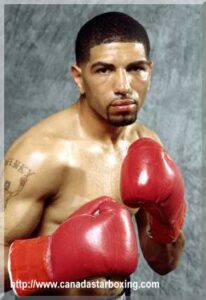
And though an easy win or two would have been a fitting reward for such a victory, Mosley kept his warrior’s reputation intact by fighting the toughest possible opponent in his next fight, the much-avoided Winky Wright. The two boxing superstars would engage in two exciting bouts in March and November 2004, and though Wright would win both fights via decision, many boxing observers believed “Sugar” Shane had done enough to win the rematch.
Undeterred by this chain of events, Mosley was back in the gym with new trainer John David Jackson (a former world champion himself) almost immediately. His new goal: to move back down to welterweight and dominate the division again.
The first step on that mission took place in April 2005, when Mosley made a triumphant return to 147 pounds with a lopsided ten round decision over rugged contender David Estrada. The win re-established Mosley in the division.
In September 2005, Mosley fought and beat previously unbeaten Jose Luis Cruz in aother clear-cut victory.
In his most recent bout, Shane Mosley defeated Fernando Vargas in February 2006 by a 10th-round TKO. |